

Social Innovation
← AREAS OF WORK · SOCIAL INNOVATION
Solving problems the usual sectors can't solve alone
Some problems sit in the cracks between business, government, and the nonprofit world. Social innovation is what happens when people stop accepting those cracks.
What it is
Most of the problems that follow a city year after year (poverty, housing, mental health, food access, gaps in opportunity) don't get solved by any one sector working alone. A government program reaches its funding cap. A nonprofit hits the limit of what donations can support. A business won't take it on without a clear margin. The problem sits, and the cracks between the three become the place where people fall.
Social innovation is the work of building solutions that cross those cracks on purpose. It borrows the discipline of business, the community focus of nonprofits, and the policy reach of government, and uses all three at once to address something none of them could solve on their own. It shows up in social enterprises, in tech built for public good, in mixed-use developments designed for community wealth, and in nonprofits that operate with the rigor of a business while staying anchored to a mission.
In Bexar County and the 12 surrounding counties, the nonprofit sector generated $15.3 billion in revenue and employed nearly 88,000 people across roughly 5,400 organizations in 2023. Texas-wide, nonprofits drive about $110 billion into the state's GDP. The sector is here, and it is large. What is less common is the next step: organizations that operate with the discipline and durability of a business while staying anchored to a mission.
-
What it is
Civic tech built for public good
Mixed-use community development with shared benefit
Mission-anchored businesses with a sustainable model
Nonprofits run with the discipline of a business
Cross-sector partnerships built to last
-
What it could be
Worker-owned cooperatives in service industries
Community-owned utilities and broadband
Neighborhood land trusts that prevent displacement
Regenerative agriculture as a small business model
Public-purpose AI tools built locally
-
What it is not
Charity or one-direction giving on its own
Corporate social responsibility tacked onto a regular business
Tech startups that mention impact in a pitch deck
Social media advocacy without underlying work
A nonprofit being well-intentioned but not sustainable

IN SAN ANTONIO
What it looks like here
These are two San Antonio organizations doing social innovation in different ways. One uses civic technology to make public-purpose work scale. The other turns a piece of Westside history into a working community asset. Both cross sector lines on purpose.
In practice
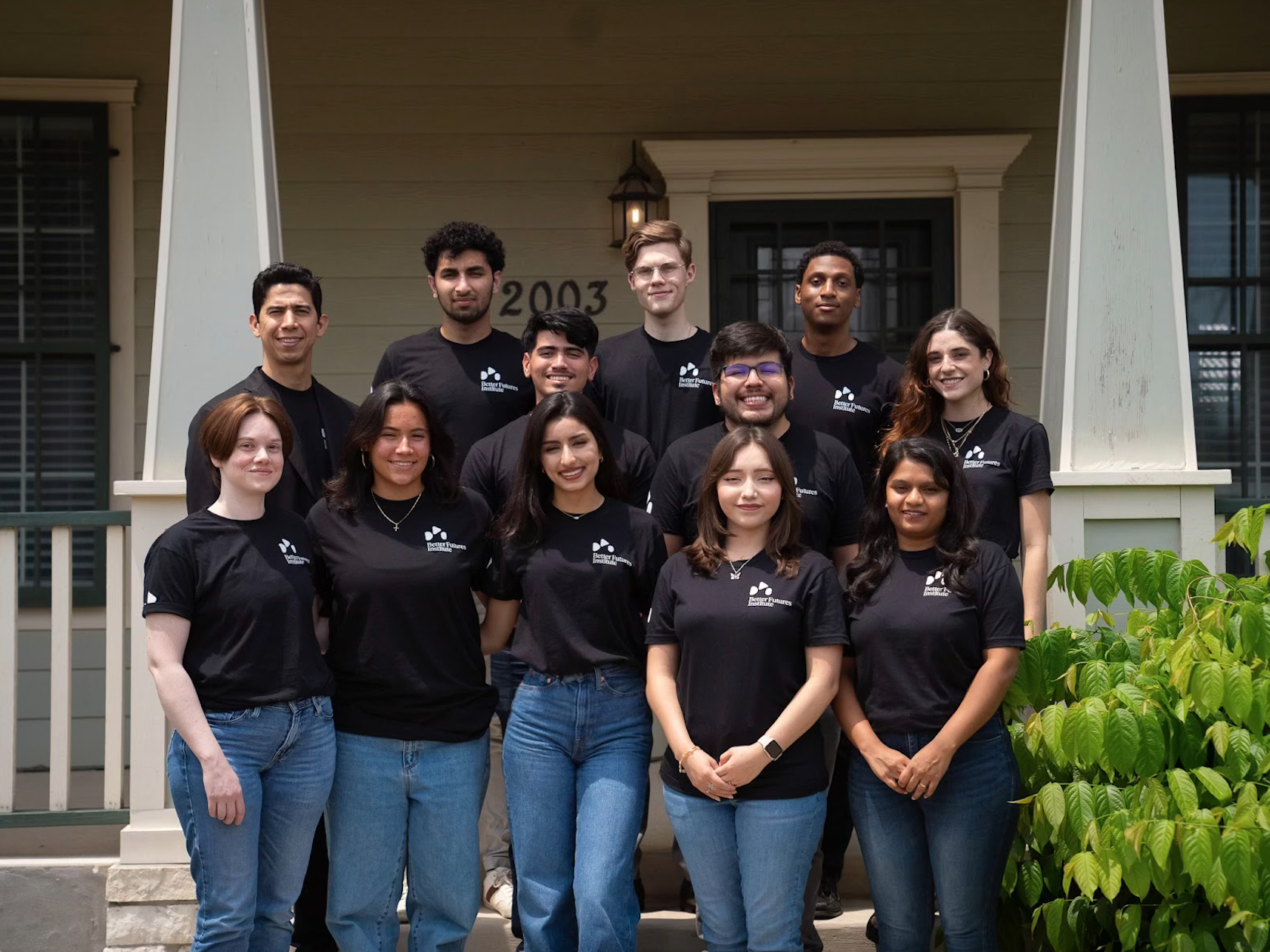
Photo courtesy of Better Futures Institute
Better Futures InstitutE
A San Antonio civic tech and research nonprofit building public-purpose AI and digital tools for cities. Their work pairs research on urban and socioeconomic development in South Texas with hands-on programs that train the next generation of civic technologists. It is social innovation through the lens of technology: putting tools that usually belong to private industry into the hands of communities and the people working to serve them.

Photo courtesy of DreamOn Group & Prosper West
Basila Frocks
The 1929 Basila garment factory on the Westside, once a workplace for generations of Latina seamstresses, is being restored by DreamOn Group and Prosper West as a mixed-use community hub. Coworking, retail, creative studios, and shared public space, anchored to the neighborhood's history rather than displacing it. It is what social innovation looks like in the built environment: a private developer and a community nonprofit working together to keep economic value where it was made.
Where San Antonio stands
The 2024 State of the Nonprofit Sector report painted a clear picture. Bexar County and the surrounding region have a large, established nonprofit base, and demand for services is climbing as pandemic-era federal funds wind down. Many of these organizations have been around for more than 20 years. They know their communities. They have the relationships. What most have less of is a revenue model that does not depend almost entirely on grants and donations, which leaves the sector exposed every time public funding shifts.
That is where social innovation has the most room to grow here. The talent is in place. So is the history of community organizing, the mix of cultures and industries, and a set of established institutions already doing this kind of work. What is missing in many places is the practical setup that lets it move faster: small business owners who know they can build mission-driven models, funders who know how to back hybrid work, and partnerships that do not have to be invented from scratch each time.
Working on something in between?
〰️
Working on something in between? 〰️
Whether you are building a social enterprise, a civic tech project, a community-rooted development, or a nonprofit that wants to operate with the discipline of a business, this is the kind of work we know how to support.



Empower Dreams: Join Us in Building Business Futures
Every donation fuels the journey of aspiring entrepreneurs in our community. Your support enables Emerge and Rise to provide essential resources, mentorship, and training to those who need it most. Together, we can transform potential into success. Invest in a brighter future today—every contribution makes a difference!